
The Future of Software Engineering, Part 2: Navigating Career Evolution in the Age of AI

In our first article, we established a foundational truth for the era of broad artificial intelligence adoption: AI should not define what humans will do; humans must define where AI is applied to support our capabilities and responsibilities. We introduced a core framework to help leaders navigate this divide, separating machine functions from human imperatives through two distinct domains of ability: INFER versus VALUE.
Machines operate in the INFER domain: flawlessly executing tasks centered around Identifying, Navigating, Formulating, Evaluating, and Recommending based on historical data and probabilistic parameters. Humans, conversely, own the VALUE domain: uniquely commanding the responsibilities to Validate, Appreciate, Lead, Understand, and Envision.
See the article here: https://www.linkedin.com/pulse/why-humans-remain-irreplaceable-age-ai-katilyst-ubxfc/
Now, we must look into the next layer of our "crystal ball." How do these cognitive domains translate into the job market? As inferential capabilities commoditize, the distribution of labor is undergoing a historic reorganization. To thrive, professionals, leaders, and parents must understand which roles are transitioning into automated infrastructure, which human-centric career paths are expanding, and how to future-proof the next generation.
The Great Contraction: Deconstructing AI-Dominant Roles
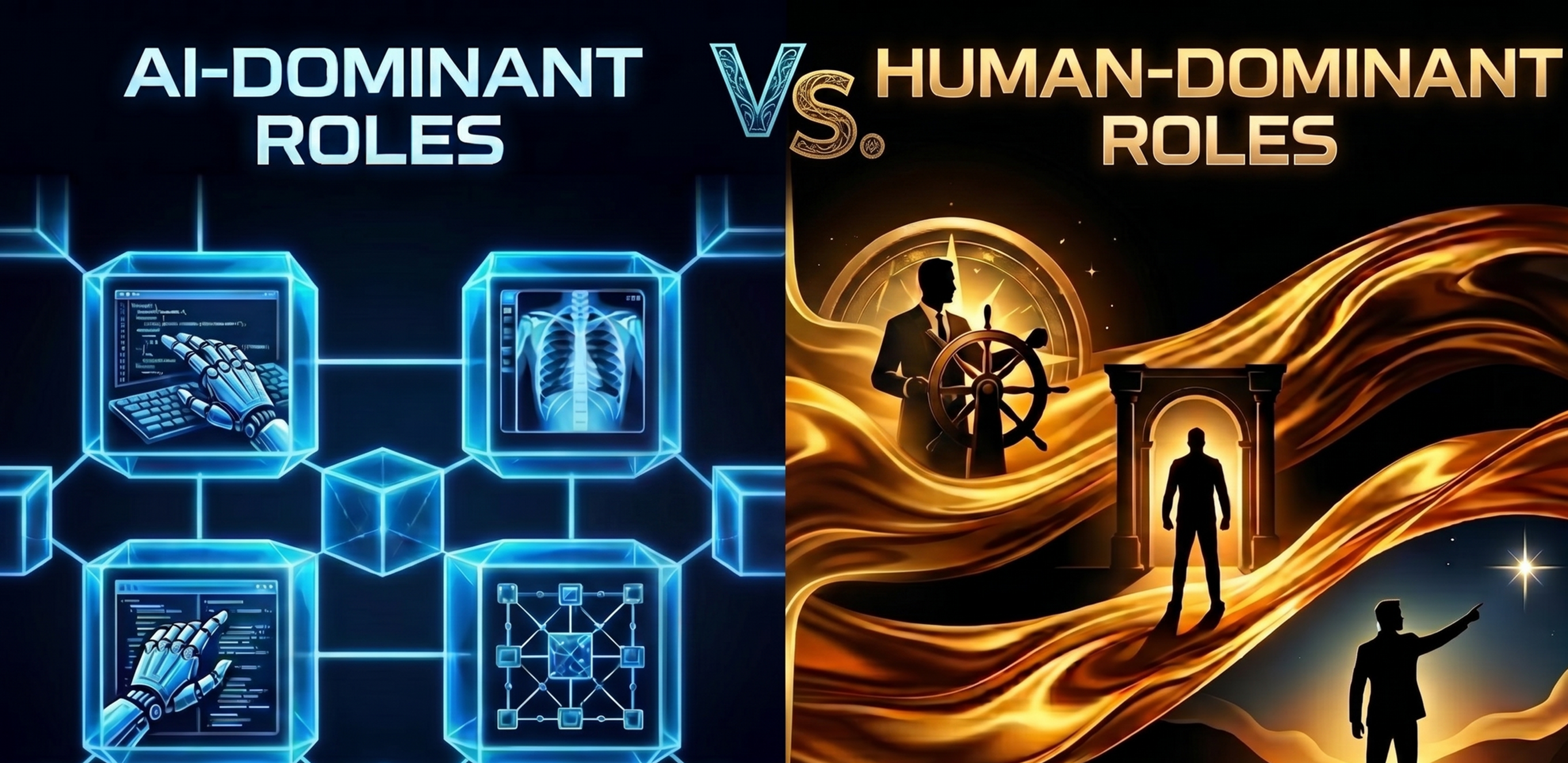
The market is rapidly dividing into two horizons: AI-Dominant Roles and Human-Dominant Roles. AI-Dominant roles are those where the overwhelming majority of daily cognitive labor falls squarely within the INFER cycle. These roles are not completely vanishing overnight, but they are dramatically contracting in terms of human headcount as they become automated infrastructure.
Five critical human archetypes are emerging as the high-impact career tracks of the future:
1. The Visionaries
Corporate and Creative Examples: Product Strategists, Enterprise Architects, Film Directors, Artists, Creative Directors
The Career Imperative: While an AI can generate thousands of candidate recommendations based on historical training data, it can only recombine past patterns. It cannot originate true intent. Visionaries operate by dreaming and imagining entirely new possibilities. They define a desired future state where no precedent exists, providing the "North Star" that aligns long-term corporate strategy and systemic innovation.
2. The Stewards
Corporate and Creative Examples: CISOs, Judges, Corporate Board Members, Industry Regulators, Specialized Financial Auditors
The Career Imperative: As automated and agentic workflows become standard infrastructure, the need for deep governance explodes. Stewards act as the vital guardians of ethics, compliance, risk, and human-centric standards. They establish the boundaries within which machine systems must operate, and they possess the systemic authority to question and rewrite organizational rules when the baseline context shifts.
3. The Responders
Corporate and Creative Examples: Cyber Incident Commanders, ER Physicians, Firefighters, Crisis Negotiators
The Career Imperative: In high-stakes, chaotic environments, lower-tier analysis can be successfully delegated to autonomous machines. For example, a security operations center can leverage AI to detect and automatically isolate minor network script alerts. However, when a systemic, complex crisis occurs, high-level remediation remains fiercely human-led. Responders apply contextual empathy and lived experience to weigh critical moral trade-offs, step into the chaos, and make the definitive, high-risk call.
4. The Coaches
Corporate and Creative Examples: Corporate Mentors, Specialized Instructors, School Teachers, Athletic Coaches
The Career Imperative: Because access to technical information and inferential generation is now completely democratized, the premium asset shifts to human development. Coaches do not merely transmit rote information. They guide long-term behavior change, build personal resilience, teach leadership values, and cultivate the specific mental frameworks required for individuals to manage automated ecosystems effectively.
5. The Leaders
Corporate and Creative Examples: Corporate Founders, Chief Executive Officers, Military Commanders, School Principals, Mayors
The Career Imperative: True leadership cannot be automated because an algorithm cannot bear the weight of consequences. An AI system can recommend a high-risk operational pivot or rank strategic optimization curves based on market trends. However, it holds no agency or free will; it carries zero accountability for the real-world outcomes it influences. Leadership exists wherever ultimate human accountability must resolve. To lead is to choose the direction, rally human commitment, and accept full responsibility when things go wrong.
Actionable Strategy: How to Shift Your Career Track
For individual contributors, managers, and technical professionals currently positioned in an AI-Dominant functional area, this structural shift is not a threat, it is an explicit invitation to elevate your professional output. To future-proof your career, you must consciously alter your daily workplace behaviors, moving your focus away from executing transactional tasks and toward managing systemic value.
Thriving in an automated marketplace requires modifying your contributions to focus on high-value human behaviors:
Validate the Automation Pipeline: Do not treat a machine's output or recommendation as an unassisted decision. Actively audit the automated outputs, testing them against real-world applicability and verifying that they serve a genuine purpose.
Provide Critical Process Feedback: Take ownership of the workflows themselves. Document where your automated tools fail, refine the contextual inputs, and actively give feedback to the process to improve its systemic alignment.
Proactively Upgrade System Frameworks: Move your attention up the stack. Dedicate your energy to upgrading shared corporate resources, common technical components, and organizational frameworks.
Identify Structural Vulnerabilities Early: Be the professional who looks beyond immediate tasks to identify hidden vulnerabilities, compliance gaps, or logical issues within external libraries or third-party packages before they disrupt the wider operation.
By reorienting your daily actions around how systems run, protect themselves, and serve human needs, you naturally transition from a functional executor into an indispensable Steward, Architect, or Visionary.
What We Must Teach Our Kids
Looking at this landscape requires a complete re-evaluation of how we mentor, educate, and prepare the next generation. For decades, traditional parental and educational guidance pushed children toward deep, hyper-specialized technical execution, encouraging them to memorize syntax, master repetitive calculations, or learn rigid, transactional mechanics.
In a world where machine inference is embedded at scale, that legacy path trains children to compete directly with highly scalable algorithms. Instead, our educational focus must swing back toward cultivating foundational human virtues rooted deeply in the VALUE domain.
Move from Syntax to Architecture
We must move away from forcing children to simply memorize the punctuation of a specific programming language or the rote steps of a standard formula. Instead, we must teach them systemic logic, structural design, and how different components interact across a wider ecosystem. They need to understand how to design the overarching blueprint and orchestrate automated tools to manifest that vision.
Cultivate Accountable Decisiveness
Because machine recommendations are frictionless and highly persuasive, the temptation for the next generation to passively defer choices to an algorithm will be immense. We must intentionally teach our children the courage to make independent decisions, articulate their rationale, and take absolute ownership of the outcomes. They must learn that true authority requires holding themselves accountable when a strategy fails.
Foster Contextual Interpretation and Empathy
The most premium human capability of the future will be the power to understand human emotion and read contextual nuance. We must encourage children to develop deep emotional intelligence, practice active listening, and interpret the "why" behind human frustrations and societal challenges. This deep context is what allows a human to validate whether an automated solution is truly serving a human purpose.
Protect the Power to Dream
We must fiercely protect our children's capacity for wild, unconstrained imagination. While machine learning is structurally bound to the patterns and data of the past, human progress relies entirely on the ability to envision departures from that past. We must foster creative exploration, philosophical debate, artistic expression, and bold ideation that consciously breaks away from conventional baselines.
Conclusion: The Ultimate Competitive Advantage
The integration of artificial intelligence into our global professional ecosystem is ultimately a behavioral coordination challenge, not a technical replacement project. As the execution-level mechanics of the INFER loop become entirely commoditized and accessible to everyone, the ultimate competitive advantage for any individual (and any enterprise) is proportional to the depth of their commitment to the VALUE domain.
True market differentiation will not come from how much data your systems can rapidly process, or how many automated outputs your workflows can generate. Lasting organizational success will come from how intentionally you preserve, elevate, and reward human responsibility within those automated systems.
The future of work is not defined by what our machines can produce. It is defined by what we, as human beings, choose to remain deeply responsible for.
What’s Next?
In our next article, we will step out of the macro career framework to focus directly on the changing landscape of software development. We will introduce the rise of a new generation of "builders", creators who leverage GenAI to build robust products, even with little to no traditional coding experience. We’ll outline exactly what these new creators should do to thrive in this landscape, mapping out the tactical shifts and new day-to-day responsibilities across product management, software architecture, development, QA, devops, and incident response.


Comments