
Why Humans Remain Irreplaceable in the Age of AI

Updated: Aug 24

The question of whether artificial intelligence will change our professional lives has largely been resolved. AI is no longer an emerging capability or a distant forecast; it is an embedded reality, increasingly integrated into how organizations operate, build products, and make decisions at scale. The AI conversation must now shift from an anxious focus on automation to a more fundamental inquiry: What should remain uniquely human in a world where machines can now perform so much of our cognitive labor?
Most organizations are still approaching this shift from an AI capability-first perspective. They ask what can be automated, what can be accelerated, and where human effort can be subsequently reduced. While this approach may yield short-term efficiency gains, it often overlooks the deeper transformation underway. The introduction of AI does not simply change workflows; it changes the distribution of responsibility. As AI systems become more capable and increasingly agentic, the primary risk is that human accountability, judgment, and meaning will be mistakenly displaced.
To intentionally design a sustainable integration of AI, we must invert the prevailing mindset and establish a clear thesis: we need to keep Humans in the Lead. Rather than focusing solely on what machines can do, we should begin by defining what humans must take responsibility for in order to create the best outcomes for their organizations. This is the foundation for maintaining accountability, direction, and meaning. Only from that foundation can we then determine what can be automated or delegated to AI. The challenge, then, is not simply to deploy AI effectively, but to design systems where human responsibility is explicit, intentional, and preserved.
In other words, AI should not define what humans will do. Humans should define where AI is applied to support their capabilities and responsibilities.
To clearly reason about the distinction between human and AI tasks, it is helpful to separate their two distinct domains of abilities. On one side are the strengths of machines: the ability to Identify patterns, Navigate complex information spaces, Formulate outputs, Evaluate against constraints, and Recommend actions. On the other side are the human capabilities: the ability to Validate outcomes, Appreciate meaning and experiences, Lead with accountability, Understand context, and Envision futures that do not yet exist. For simplicity, we will refer to these two domains using the mnemonics INFER and VALUE in order for them to serve as a memorable shorthand for two fundamentally different types of work that must remain distinct, even as they increasingly operate together.
Let’s break down both domains in more detail.
The Anatomy of the Machine: AIs INFER
To lead AI effectively, we must first understand what it is: a highly capable engine for inference. AI excels at processing, synthesizing, and pattern-matching data at a scale and speed that exceed human cognitive limits. These machine capabilities can be described through the mnemonic INFER.

(I)dentify: AI is uniquely suited to detect subtle patterns, signals, and complex relationships within vast, unstructured datasets. However, what is identified is entirely bounded by past data; AI does not "notice" context outside its training, it surfaces statistical significance.

(N)avigate: AI can traverse massive information spaces, simulate alternative scenarios, and explore complex solution paths at incredible speed. Yet, this navigation is not self-directed; AI explores based on the constraints and objectives defined for it by human creators.

(F)ormulate: AI is a generative powerhouse, producing text, designs, predictions, and candidate outputs. This is often mistaken for genuine creativity, but it is more accurately described as probabilistic construction, recombining learned patterns rather than originating true intent.
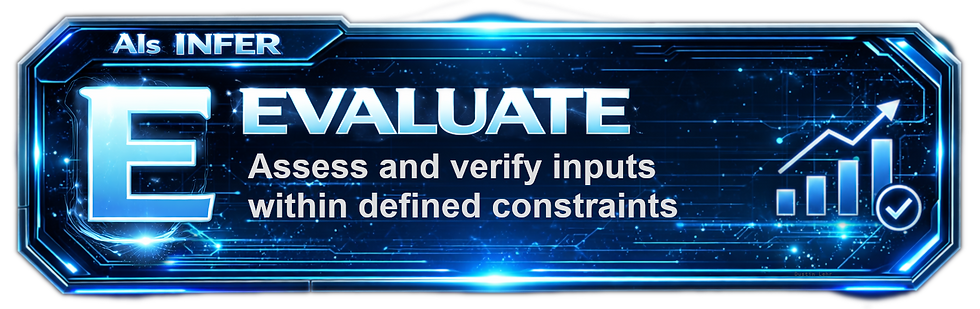
(E)valuate: Within predefined rules and parameters, AI can assess inputs and outputs, enforcing policies and verifying consistency with tireless rigor. However, it cannot question the validity of those rules, nor can it recognize when a baseline constraint has become obsolete.

(R)ecommend: AI systems can rank options and suggest next actions based on patterns and constraints. However, a recommendation is not a decision. It reflects what is statistically likely or optimized, not what is contextually appropriate. It carries no accountability for the outcomes it influences.
Taken together, the AI domain defines what could happen based on historical patterns and defined constraints. It expands the horizon of technical execution and serves as a powerful amplifier of human capability. At the same time, it does not provide intent, meaning, or responsibility. Those remain outside the domain of the machine.
The Nature of Our Role: Humans VALUE
To lead effectively in an AI-enabled world, we must recognize what remains fundamentally human: the responsibility to define direction, assign meaning, and be accountable for outcomes. While machines expand what is possible, humans decide what is valuable. These human responsibilities are captured by the mnemonic VALUE:

(V)alidate: While AI can verify whether an output meets technical criteria, validation determines whether those criteria were appropriate in the first place. It introduces intent into a system, confirming that an outcome truly serves real human needs and aligns with a broader purpose.

(A)ppreciate: Humans do not simply process information in the world around them; they consciously experience it. We read, watch, play, and engage with content because of how it feels, not just what it contains. We allow stories, ideas, and experiences to affect us, to shape our thinking, and to create meaning. The ability to recognize, shape, and deliver experiences for other humans will continue to be a market differentiator.

(L)ead: To lead is to choose a direction and actively accept responsibility for the consequences of that choice. This is an entirely human function because leadership requires accountability, agency, and free will. We do not and will not hold machines accountable, so when an automated system fails, responsibility inevitably traces back to the people who designed or deployed it.
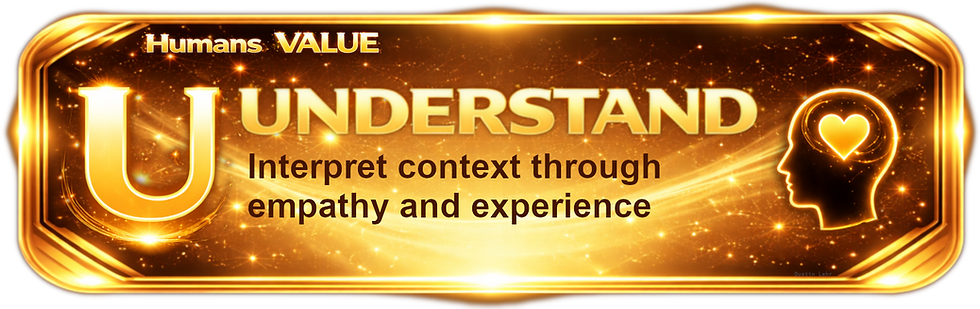
(U)nderstand: Understanding extends far beyond information processing for contextual interpretation. It involves applying empathy and connecting lived experiences, allowing humans to consciously interpret nuance and make sense of complex human behavior that cannot be reduced to structured data points.

(E)nvision: While AI generates outputs by identifying patterns in historical data, humans possess the ability to originate entirely new possibilities. We define futures that are not extensions of the past, but departures from it, shaped by intention, creativity, and purpose. This capability enables direction-setting in the absence of precedent and forms the foundation of strategy and innovation.
Taken together, these capabilities define the domain where human responsibility must remain firmly rooted. They are not tasks to be optimized or delegated, but instead are meant to be embraced and owned. While AI can extend our reach, it cannot replace the role humans play in determining what matters, what is right, and what comes next.
Flipping the Model: Start with Humans, Not AI
When organizations build their strategy around what AI can do, they often do so with the intention of increasing efficiency. In practice, however, this approach can have an unintended consequence by gradually removing humans from the decisions that matter most. As machine recommendations carry implicit authority, professionals can easily slip into treating them as definitive decisions. Its ease of use can wedge its way in as a substitute for human judgment.
This is not a technical failure; it is a behavioral one. When humans stop validating, questioning, and owning outcomes, accountability erodes, and the organization can begin a gradual, quiet drift away from its core purpose.
To prevent this erosion, we must flip the model entirely. Instead of starting with AI capabilities and asking what is left over for people, leaders should first define human responsibilities. We must explicitly decide what humans should not give up by design. Only when human boundaries are defined should AI be introduced to amplify and accelerate the inferential tasks underneath.
A Concrete Example: The Production of This Narrative
The development of this very text provides a practical example of how the AI and human domains interact fluidly and iteratively. The process was not linear; it was a continuous coordination between human and machine capabilities applied dynamically throughout. The following describes the human contributions
Validate: Throughout the drafting process, the concepts were continuously validated against real-world applicability to ensure the arguments were not just technically coherent, but deeply meaningful to an executive audience.
Appreciate: The language and structure were refined through the lens of human appreciation: recognizing the cadence, impact, and clarity that would truly resonate with human readers while they experience it.
Lead: Critical decisions had to be made about what concepts to emphasize, what tone to strike, and what stance to take. This exercise of leadership meant taking absolute ownership of the final narrative.
Understand: Optimizing the text required deep understanding, interpreting the broader landscape of corporate automation, recognizing widespread operational anxieties, and grounding the argument in observed organizational behaviors.
Envision: The article began with the act of envisioning a desired future state, defining a specific perspective that we wanted to express, in order to create clarity around this complex topic.
Concurrently, throughout the process, AI assisted to Identify thematic overlaps across raw materials, helped Navigate alternative structural layouts and Formulate initial draft iterations, and worked to Evaluate consistency across text segments. It also served to Recommend specific phrasing, structure, and emphasis, suggesting improvements in phrasing, structure, and emphasis. These contributions drastically accelerated the output, but they did not define its purpose. At every stage, the guiding principle was not what the machine could generate next, but what decisions were necessary to achieve the desired outcome.
The Emerging Shape of Work
As the AI domain becomes highly commoditized, the nature of professional work is undergoing a significant redistribution of responsibility. We see a future where organizational roles will separate into two clear horizons:
AI-Dominant Roles: Contexts heavily reliant on processing information, optimizing pre-existing frameworks, and generating predictable outputs, such as traditional analysts, copywriters, and baseline optimizers.
Human-Dominant Roles: Contexts rooted deeply in decision-making, judgment, ethics, empathy, and systemic accountability, such as leaders, visionaries, coaches, and stewards.
In highly technical fields like software development and cybersecurity, this shift is rapidly transforming traditional career trajectories. The role of the software engineer is evolving away from the tactical mechanics of writing routine syntax, which AI agents can handle seamlessly. Instead, the human challenge is moving toward higher-order functions: becoming Visionaries who envision product paths, Stewards who guard architectural compliance, and security-minded Technical Product Architects who validate that the system's output genuinely solves human problems securely.
The future of work is not a zero-sum competition between biological minds and silicon models. It is a profound invitation to reclaim the parts of our careers that make us most human. The ultimate success of an enterprise will not be defined by what its machines can produce, but by what its humans choose to remain responsible for. Using the mnemonics of INFER and VALUE, we hope we’ve given you a clear lens through which to view both current and ongoing innovation in the AI age.
What’s Next?
In our next article, we will build upon this framework to explore the practical reality of our shifting job market. We will conduct an exhaustive deep-dive into the specific corporate functions becoming AI-dominant, and outline the new, high-impact human archetypes that will have to emerge to define the next decade of leadership in this emerging technology space.


Comments